
PREFACE
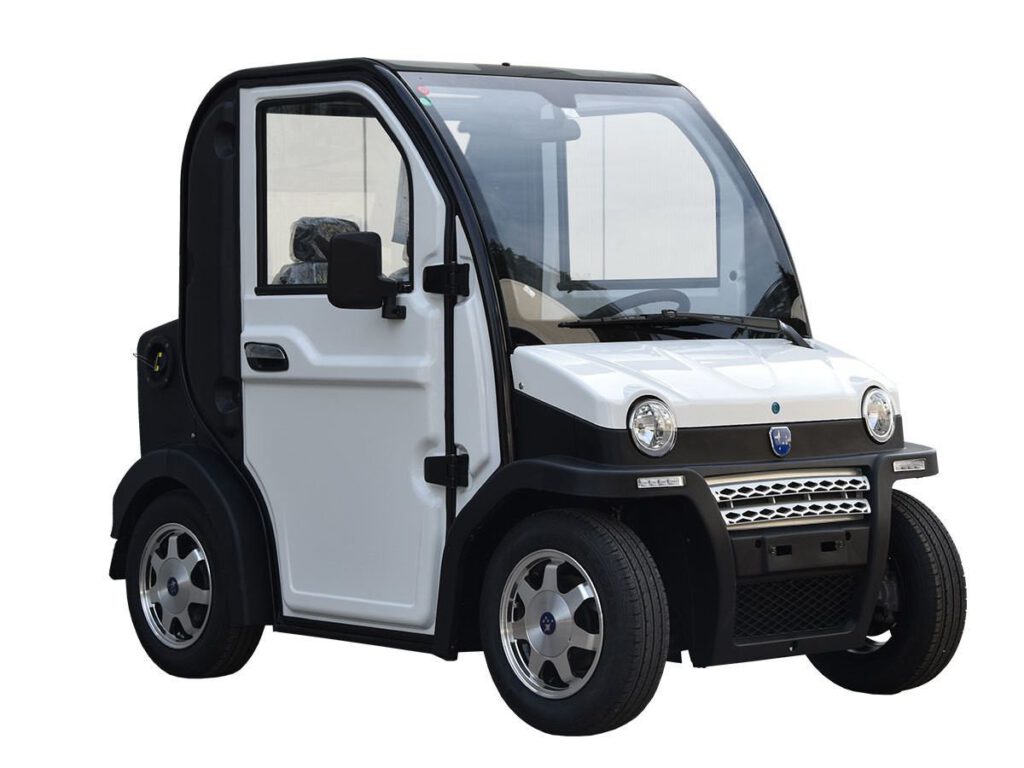
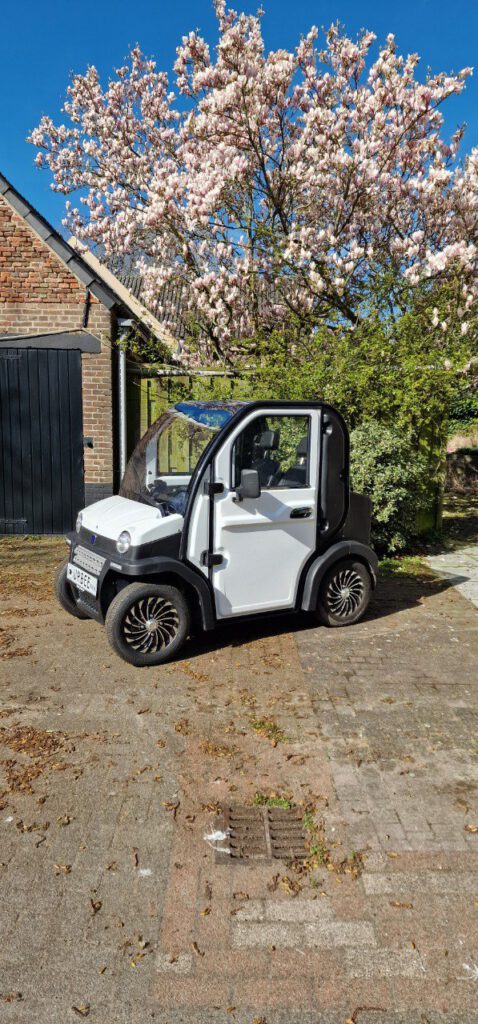
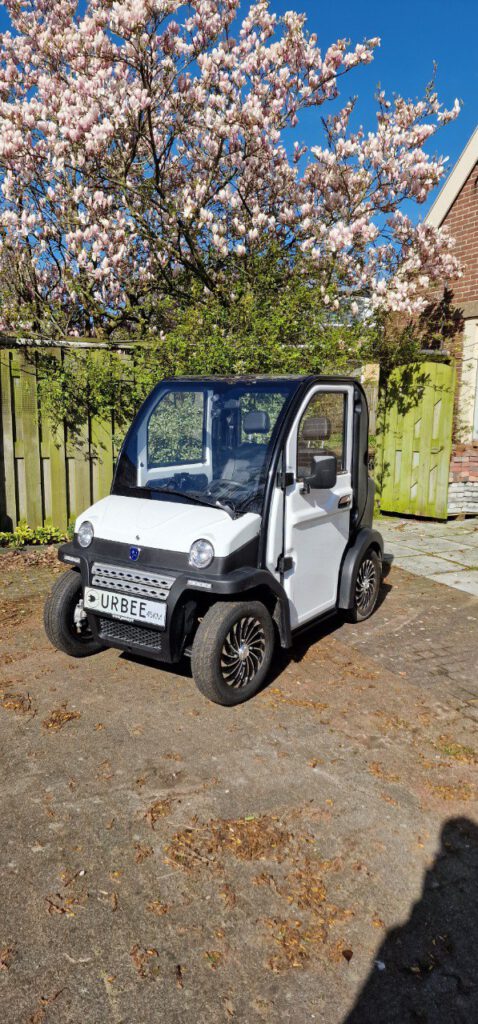
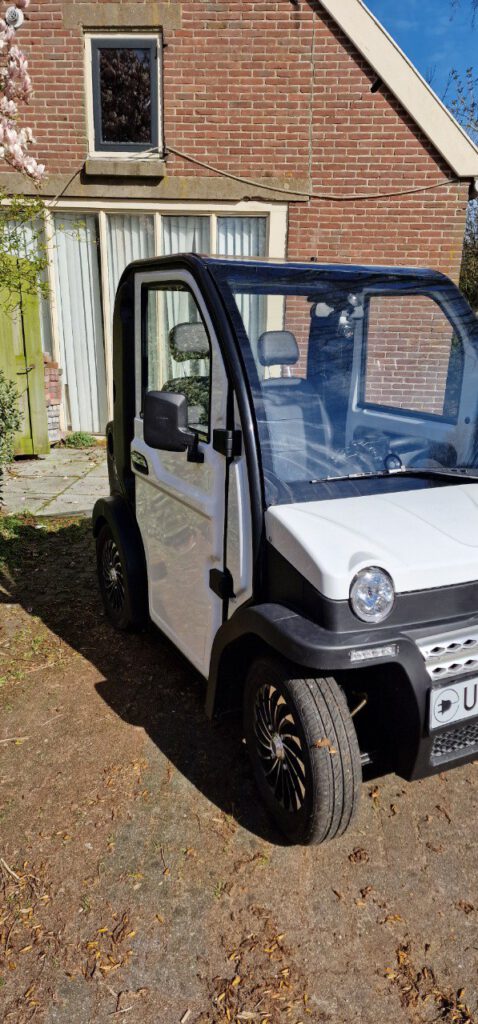
Thank you for choosing a JONWAY vehicle.
Before driving, please read this manual to get to know your Jonway Urbee. It will help you to obtain the maximum pleasure from your vehicle and decrease driving failures. You should always keep this manual in the vehicle and pass them on to the new owner if you sell the vehicle.
All data referred to in this manual is up-to-date. As Zhejiang Jonway Automobile Co., Ltd is constantly updating its vehicles to the state of the art, this manual may be renewed without immediate notice.
Note: Optional equipment is also described in this manual, so there may be some explanations which do not conform to your vehicle.
ATTENTION
- Make sure you wear the appropriate safety belt correctly.
- Inspection before driving:
- if all the lights are working well;
- if windshield and rearview mirrors are clean;
- if the position of rearview mirror is right;
- check the tyre pressure and tyre abrasion;
- Braking
- avoid vehicle sliding when the power dies out;
- the abrasion of brake lining depends on working conditions, and its replacing frequency depends on the driver’s habits and braking modes;
-make sure parking brake has been drawn back before leaving the vehicle;
- If any warning tell-tale lighting occurs during driving, please park the vehicle and check at once;
- Electric appliance accessories
- All electric appliance accessories should be connected in the required position in the right way by a repair station;
- Please maintain the vehicle according to the maintenance plan;
- For detailed operation instruction of the Radioplayer we refer you to the “Radio Player Operation Instruction”;
- All the operations should be conform this manual. We are not responsible for any direct or indirect damages resulting from incorrect operations;
- No unauthorized repairs should be made, especially with such essential parts as the electric appliances, brakes, steering, suspensions and tyre systems. Zhejiang JONWAY Automobile Co., Ltd is free of any responsibility for any direct or indirect damage due to unauthorized refits/repairs.
- We beg your pardon for the fact that the vehicle is constantly being updated. Descriptions and figures in this manual may not be conform your vehicle completely.
CONTENTS
Section 1 Important notification
Section 2 Vehicle instruction and dash board
Section 3 Start and driving
Section 4 Meter and control device
Section 5 Emergency situations
Section 6 Cleaning and maintenance
Section 7 Parameter and specifications
Section 8 Loading and unloading
Section 1 Important notifications
Some signals showed in the manual are as follows:
- This signal notes the best way to use your vehicle.


Section 2 Vehicle instruction and dash board
Vehicle instruction

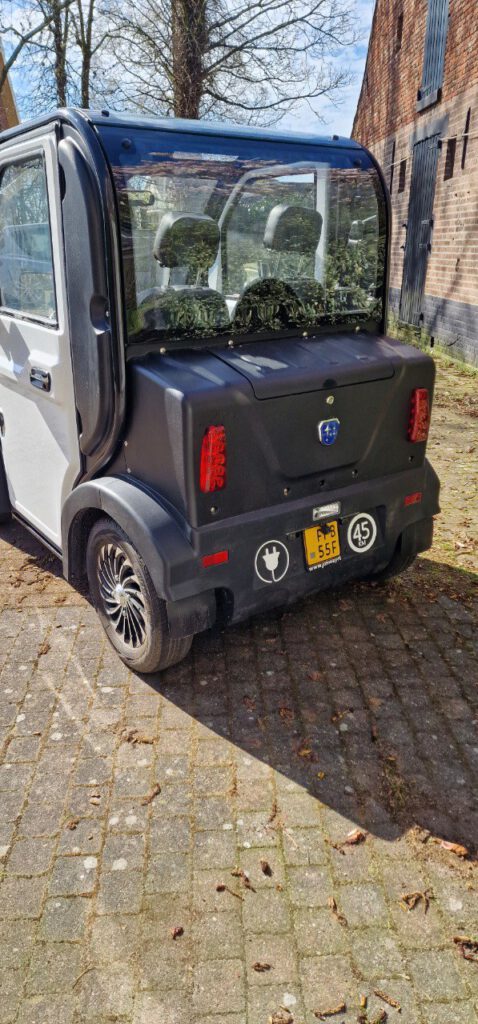
1, Rear combination light 2, License plate position 3, Reflector 4, Reverse light 5, License plate light 6, Rear glove box
Dash board Pic-1
Vehicle instruction
Dashboard
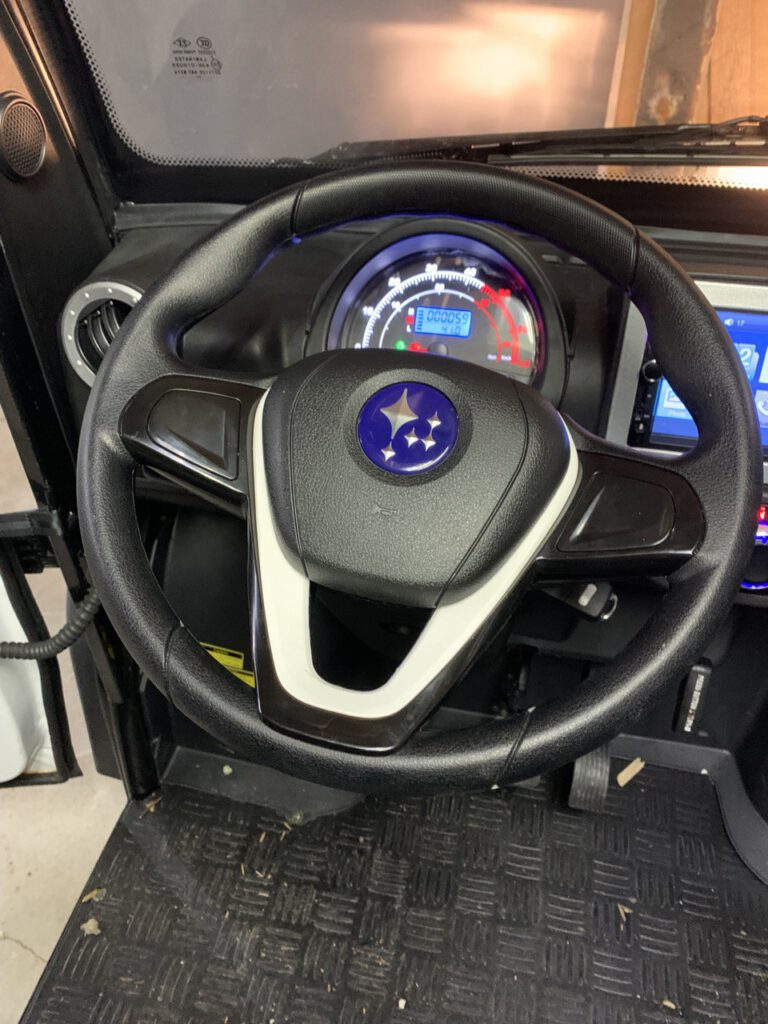
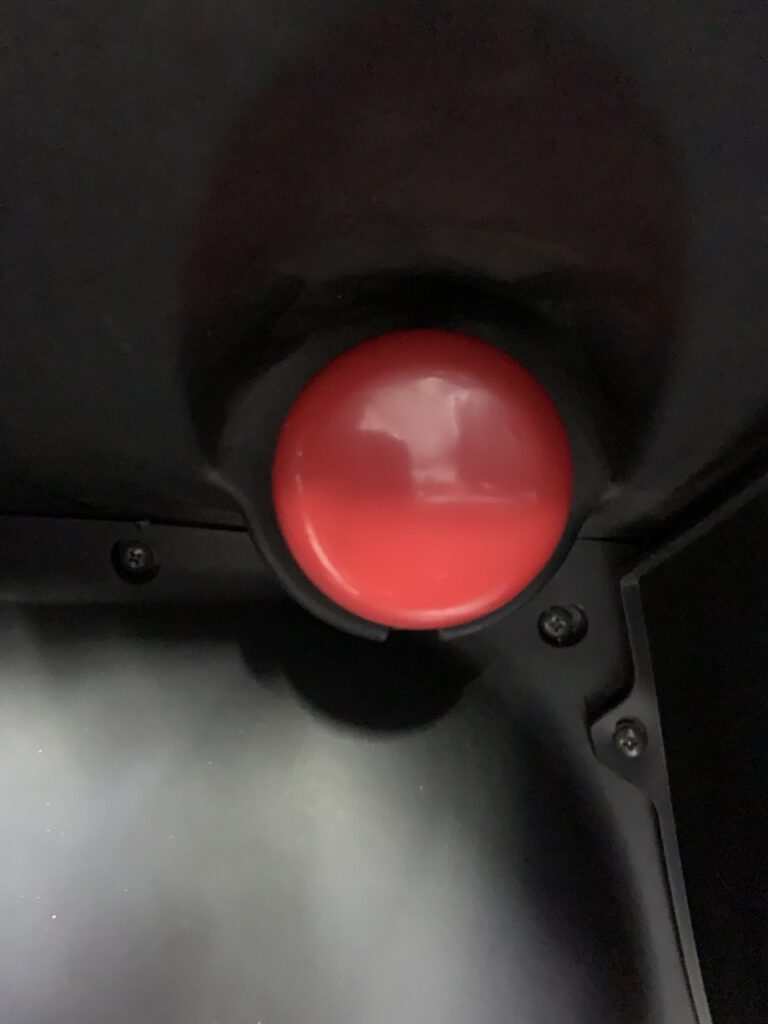
Steering wheel Horn button
Headlight/signal switch Accelerator pedal Brake pedal
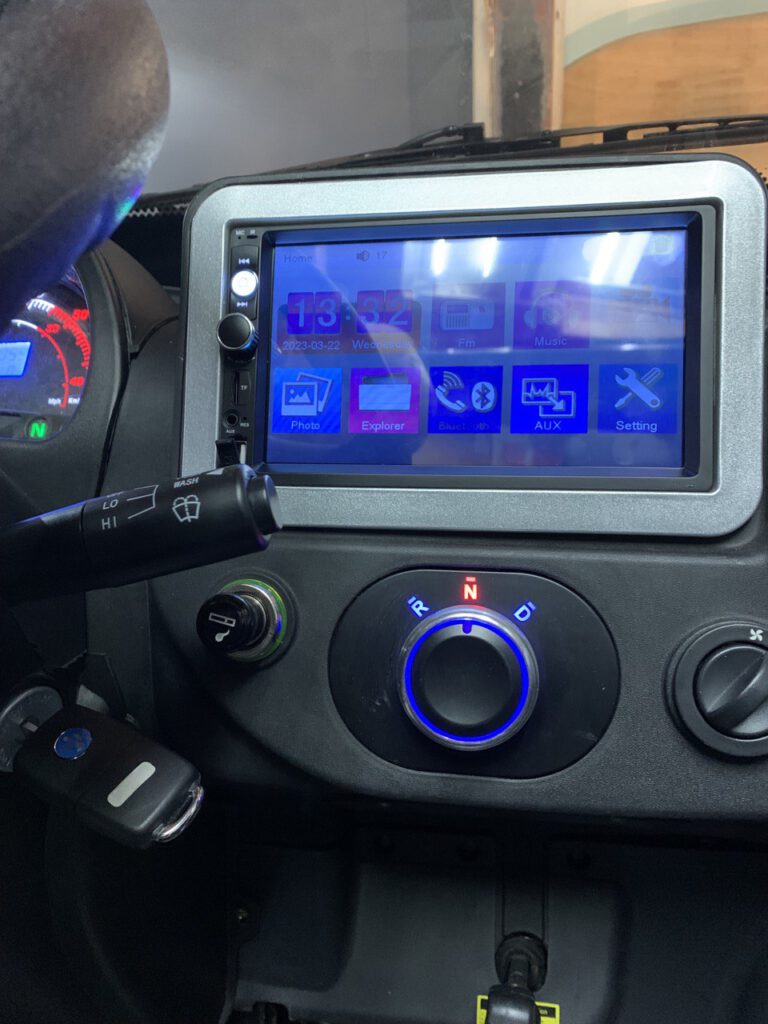
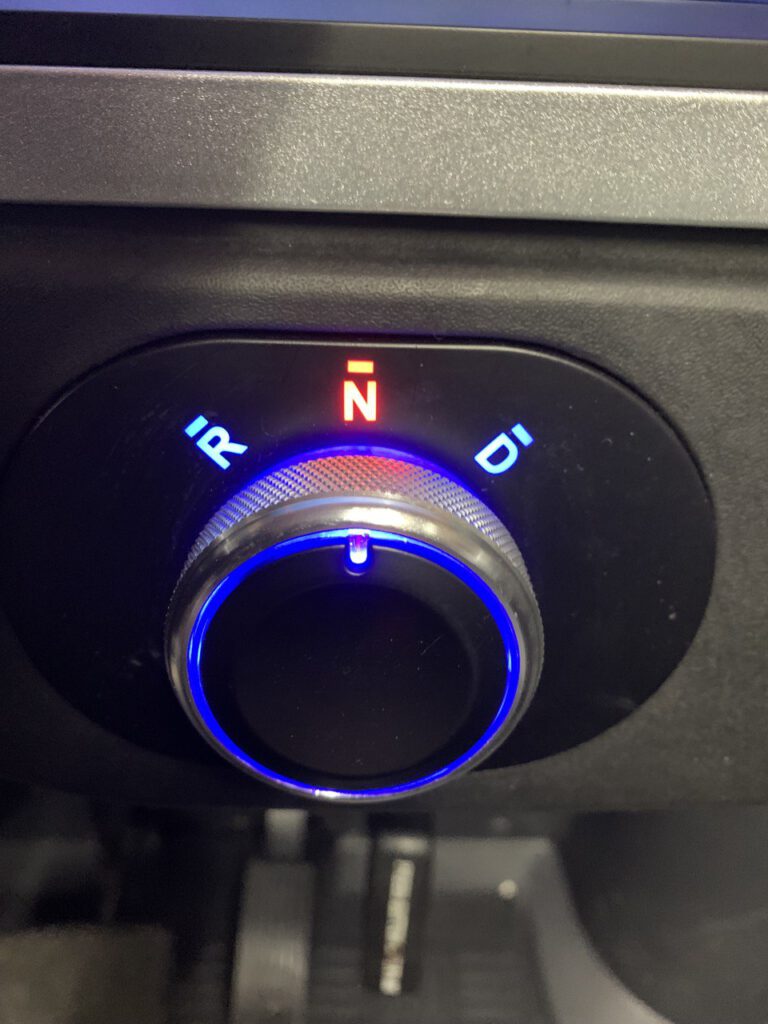
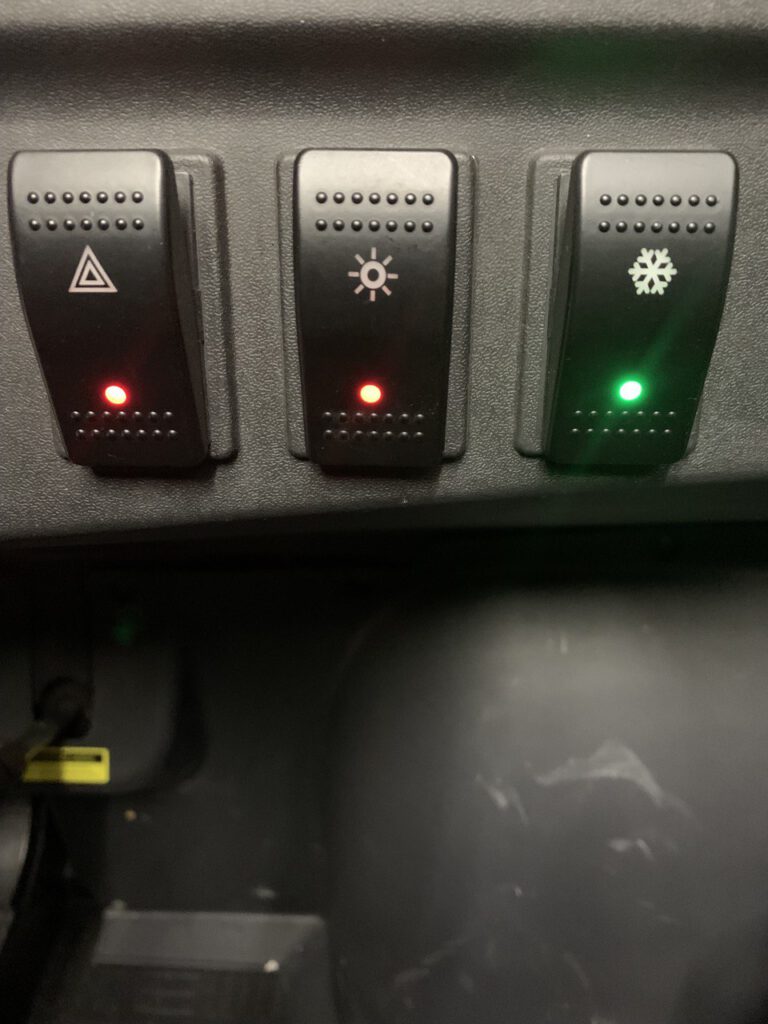
1, Meter 2, Shift handle 3, Wiper switch 4,Warning flasher 5, Warm wind switch 6, Nature wind switch 7, RH vent
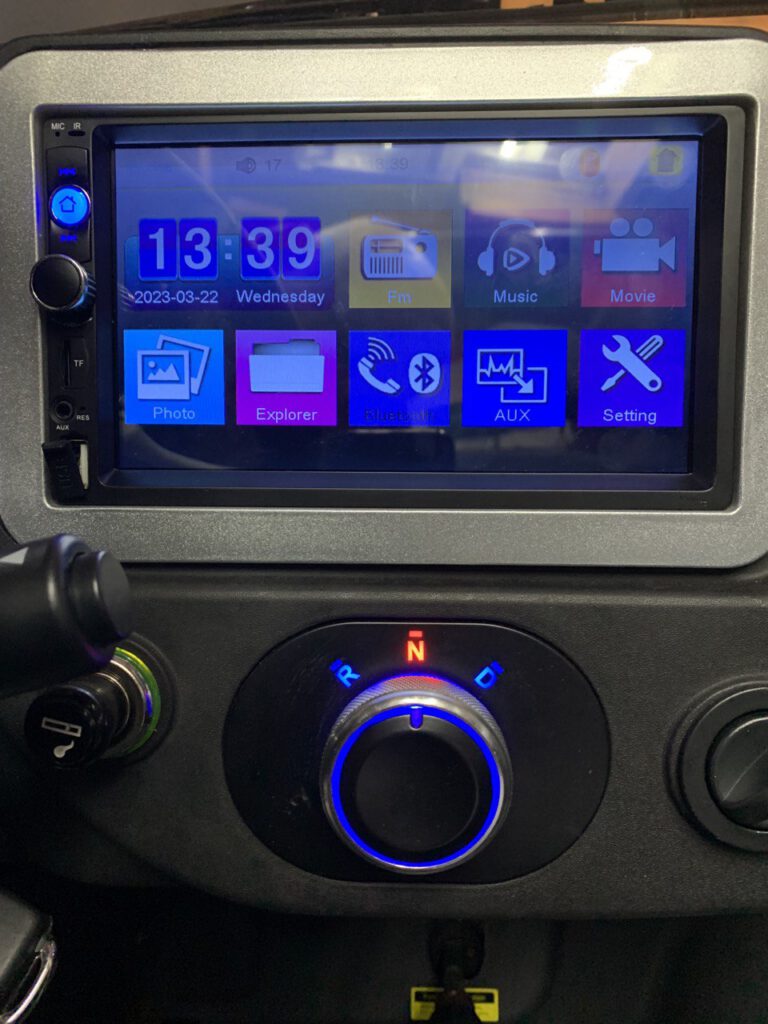
8, Radio 9, Ignition switch
10, Parking handle 11, Cigarette lighter

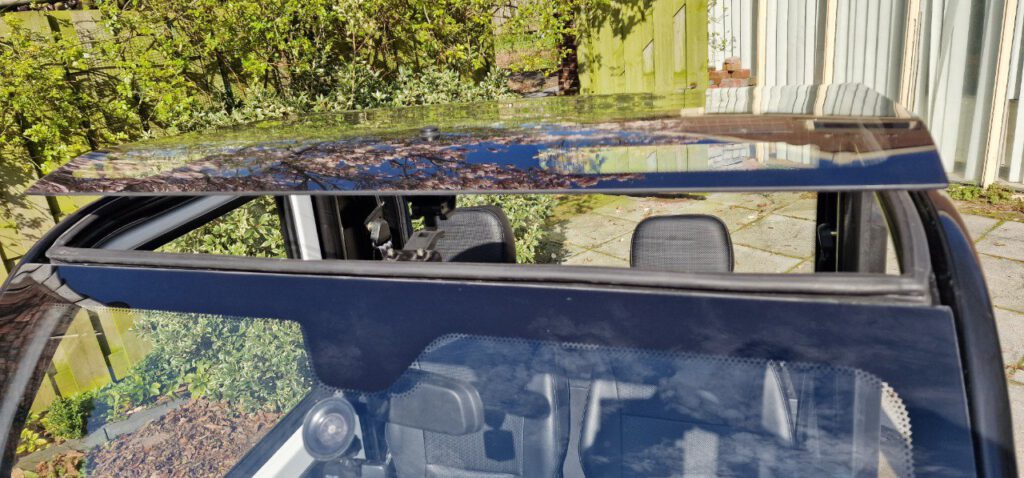
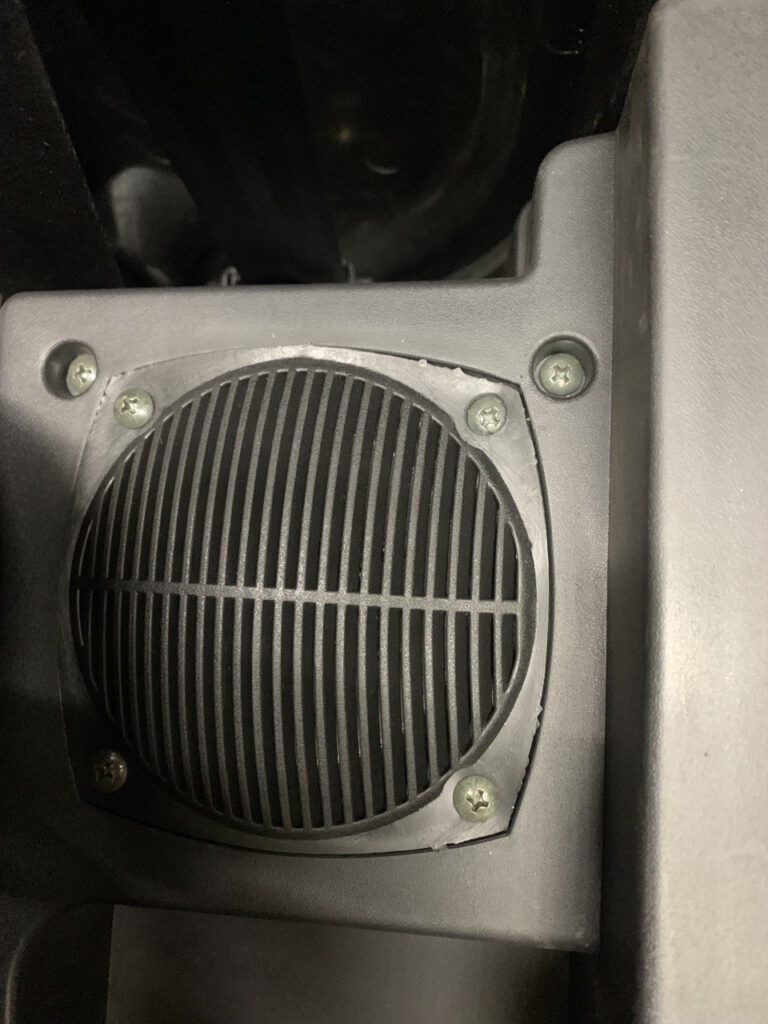
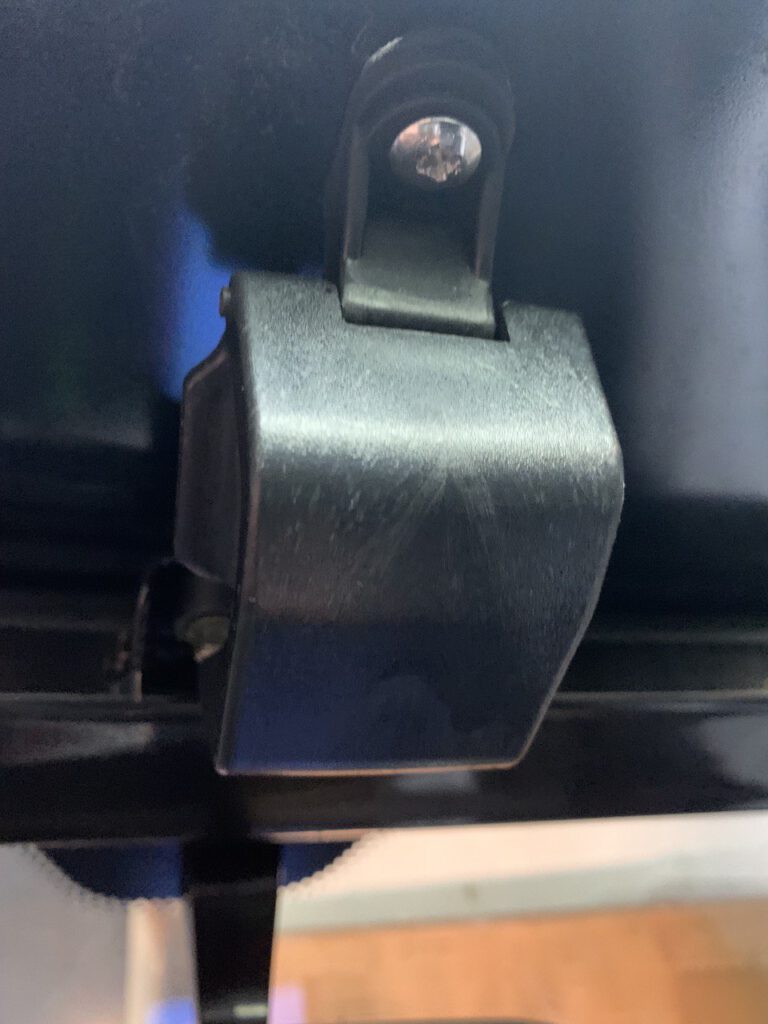
1, Sunroof 2, Front windshield 3, Rearview mirror 4, Windscreen wiper 5, Front hood 6, Headlight 7,Left turning light 8,Front wheel 9, Rear wheel 10, Charging interface 11, Antenna 12, Roof rack (optional), 13 RH speaker LH speaker
Section 3 Starting and driving
1, Starting notification
- Make sure the charger has been pulled out;
- Shift lever to N position;
- Key in ignition; make sure every indicator and signal light is normal.
2, Start procedure
⑴ Turn on emergency switch;
⑵ Turn on ignition switch, meter and indicator self-inspection;
⑶ Shift to D or R position;
⑷ Step gently on the accelerator pedal and release the parking handle at the same time.
3, Stop vehicle
Please operate the base according to the following steps:
⑴ Shift to N, pull the parking handle tight, then turn off the vehicle;
⑵ If the vehicle stops on a steep slope, please turn the wheel to the sidewalk and jam the wheel by means of a stone or block. If it takes a long time to leave the vehicle, please press the emergency switch and cut off the main power.
⑶ Don’t leave the key at “ON” position to avoid battery discharge and remember to pull the key out and press the emergency button.
⑷ Don’t leave children alone in the car, and pull the key out and take the key with you, if you leave the vehicle.
4, Parking
⑴ Pull up the parking lever, don’t press the button.
⑵ Before driving, make sure to release the parking lever completely. The concrete procedure is: press the button, then turn the lever to the right hand side, then release the lever.
⑶ Parking note:
a, When you park the vehicle uphill, please shift to N gear, and turn the wheel to the sidewalk, jam the wheel by a stone or block.


b, When you park the vehicle downhill, please shift to N gear, and turn the wheel to the sidewalk, jam the wheel by a stone or block.

c, Please pull the key out if you leave the vehicle, press the main power switch and lock all doors. Please try to park your vehicle in a lighted place.
5, Brake system
⑴ All of the brake system parts are safety parts, so please maintain your vehicle in your JONWAY after sales service center periodically.
⑵ The brake system uses hydraulic brakes, this means the braking effect is more clear and effective. Please stop your vehicle if the brake system has defects, and contact your nearby service centre immediately.
⑶ When driving in the rain, through large puddles, or after washing, the brake discs can form a layer of water film. This will influence the normal braking effect, if this happens, please drive slowly and check brake performance, till ensured that there are no problems, then drive normally.
- Special note: please replace the brake tube in repairing to ensure its seal.
6, Shift using
7, Economy speed
Please drive the vehicle in constant speed to maximize the range. The driver can adjust the speed base on vehicle condition and loading.
8, Preparation before driving
⑴ Ensure safety, please inspect seat, safety belts etc.
⑵ Please make sure everybody has fastened their safety belt and locked their side doors, inspect your rearview mirror.
⑶ Inspect if all the indicators on the meter are ok.
⑷ Please check defrosting model after choosing it, you should be able to feel the wind blow against the windshield.
⑸ Check the tire tread and the degree of wear. Pay attention to stone, nails, glass or other sharp objects on tire tread, whether it is a scratch, abrasion or other deficiency. Once found, please replace the tire immediately, and inspect the
causes of abnormal wear. Check the tire nuts and tighten them, check whether the tire pressure is appropriate or not.
⑹ Please check if the indicator light, turning signal and other indicators on meter are ok or not.
⑺ Step on the brake pedal many times, you should feel a little resistance. If you feel the brake pedal brakes too lightly or moves too big, please go to your JONWAY service center to inspect the brake system or adjust the brake pedal.
⑻ Please check the battery and cable, battery capacity will be lower in cold weather.
9, Running-in period suggestion
⑴ In the first 500 Km running-in period, please drive in slow speed to extend your vehicle’s life with good economy and power.
⑵ Don’t start your vehicle in fast speed, don’t speed-up rapidly, brake hard and keep high speed for a long time.
⑶ Don’t drive over 30 km/h speed in the running-in period, and also don’t go faster than the speed limit speed.
⑷ Please don’t overload.
⑸ Please don’t tow vehicle.
10, Driving tips
Although the vehicle has safety equipment and you will try to drive your vehicle safely, we cannot guarantee that no accidents or injuries will occur. If you pay attention to the following aspects especially, they will protect you and the other passengers.
⑴ Drive carefully, pay attention to the traffic, road and weather conditions. Keep sufficient and safe distance with other vehicles.
⑵ When changing lanes, please observe rear view mirror and light indicator light in advance.
⑶ Please observe other vehicle’s actions and signaling lights, cyclists and pedestrians.
⑷ In a vehicle emergency stop, please press emergency light button.
⑸ When driving on the water surface in rainy day , please travel slowly, the wading depth cannot exceed the frame bottom, avoiding the water to reach the motor inlet.
⑹ Accelerate slowly and steadily. Avoid unnecessary acceleration and braking. Keep a constant speed as far as possible.
⑺ You must obey the traffic rules and be a good driver.
⑻ Always keep driving safely. Please turn slowly, avoid emergency turns or sudden movements. Improper operation will result in losing control or rolling over.
⑼ In case of an accident, safety belt wearers are significantly better off than non-seatbelt wearers. So before leaving with your vehicle please ensure that you and others are properly fastened by the safety belt.
⑽ Overcrowding and overloading are prohibited.
Do not drink and drive!
Don’t pull the inner door handle while driving, avoid the door to unexpectedly open, causing an accident.
11, Vehicle inspection
Below are a few items to save costs and reduce harmful emissions:
⑴ Vehicle maintenance
Please inspect and maintain vehicle base on ”JONWAY electric sightseeing vehicle maintenance manual”.
⑵ Tire
Often inspect if your tire is normal or not, also inspect whether the tire bulges or scratches, and if there are abrasions or other deficiencies. Once found, please replace the tire immediately, and examine the causes of abnormal wear. At the same time you should also check regularly if the tire pressure is within the normal range.
⑶ Excess load
Don’t load too heavy, the weight of the vehicle (especially driving in the city) and its stability will directly affect the stability of the vehicle.
⑷Electrical devices
Strictly limit the active time of the electrical equipment such as the headlights, wipers, and the fan of the heating device, because they require a lot of energy and overactive use of these devices reduce the range of the vehicle.
⑸ Driving
Please keep a constant speed, driving with economy speed ensures the lowest power consumption.
12, Winter tires
If you decide to use the winter tires, please ensure that the four wheel installation matches the winter tire and tire pressure.
⑴Because of its special characteristics, long time running under normal environmental conditions, the performance of these winter tires will be below the performance with normal tires as proven by the tests, so you need to limit the use of
winter tires.
If the same tire (brand and appearance) is assembled to the wheels, it will ensure the operation of optimal security, braking and good operability. What needs to be reminded is that the direction of rotation of the tire cannot be reversed, and if applied wrong, four tires must be replaced.
⑵Tire anti-skid chain
The appliance of tire anti-skid chains depend on the current standards in different countries. Snow chains are attached to the drive wheels (rear). After ten meters, please refasten the anti-skid chains.
⑶ The running speed of the vehicle with snow chains should not exceed 30km/h, or the maximum speed recommended in snow chain maker handbook.
13, Long time no use of vehicle
If you want to park your vehicle for a long time (more than a week) follow the instructions below:
⑴ Park the vehicle in an open, dry and ventilated place as much as possible.
⑵ Tighten the parking handle.
⑶ Charge the battery fully and cut off the main power switch.
⑷ Clean and protected the parts with protective wax.
⑸ Clean and protect the metal parts with special products.
⑹ Slightly open the windows.
⑺ Cover the sightseeing car with silk or hollow plastic tarpaulin. Don’t use a tight plastic cloth, it will hinder the sightseeing car surface moisture evaporation.
⑻ Keep normal tire pressure and perform a periodic inspection.
⑼Please press the emergency button, cut off main power after parking the vehicle.
14, Warning label
Please carefully read the sunroof opening precautions and emergency switch using label.
⑷ In colder temperatures the battery activity will decline, the range will be shorter in winter than in summer. This is a normal phenomenon.
⑸ Battery cannot be left to stand alone for too long a time. It needs to be recharged once a month otherwise it will greatly influence the service life of the battery.
⑹ When battery energy is exhausted, the system will automatically cut the power off. But after that, the battery will rebound “virtual” voltage (voltage without power), so it needs to be charged before using the “virtual” voltage, otherwise it will cause excessive battery discharge. It will damage the battery and that cannot be repaired.
⑺ New battery has been charged in the factory, but not fully. The instrument display in full power is “virtual”, the user needs to charge in time according to the use of it.
⑻ Vehicle range: actual range will be affected by many factors (such as frequent braking, starting, a rugged road, steep slope, underinflated tires, overloading, environmental temperature etc.).
⑼ Users are prohibited to install electrical parts or refit other normal parts, otherwise the user shall bear the resulting loss.
⑽ Ensure your safety, please turn slowly.
⑾ Users are prohibited to climb for a long time. If the vehicle is in a climbing process, the speed slows down gradually, and eventually the vehicle will stop working. This is to protect the controller or the motor by means of the controller protection function, which is a normal phenomenon.
Section 4 Meter and control device
Sunroof opening precautions label Emergency switch using label
15, Notifications
⑴ After the battery indicator begins to warn you, please charge the battery in time;
⑵ If the control circuit system has faults in driving, please press the emergency switch, and tow the vehicle to a service center, then inspect and repair the vehicle.
⑶ Please drive the vehicle using a constant economical speed, ensuring the maximum range, battery and motor service life.
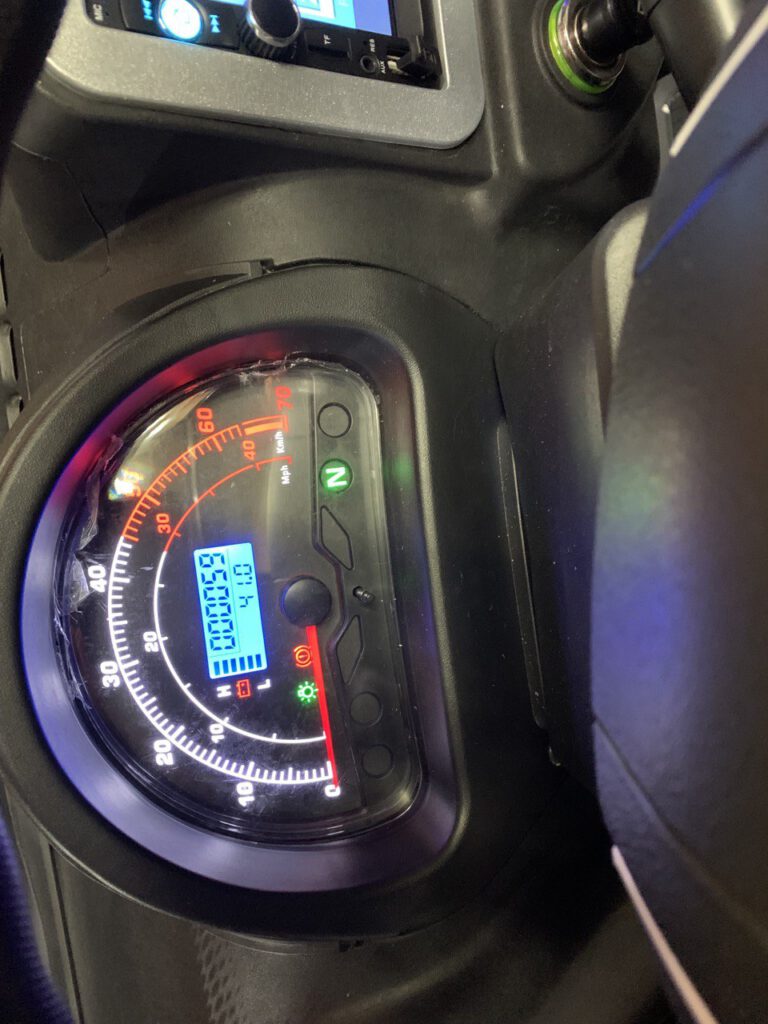
1, Meter
Speed meter Odometer Subtotal odometer
Odometer
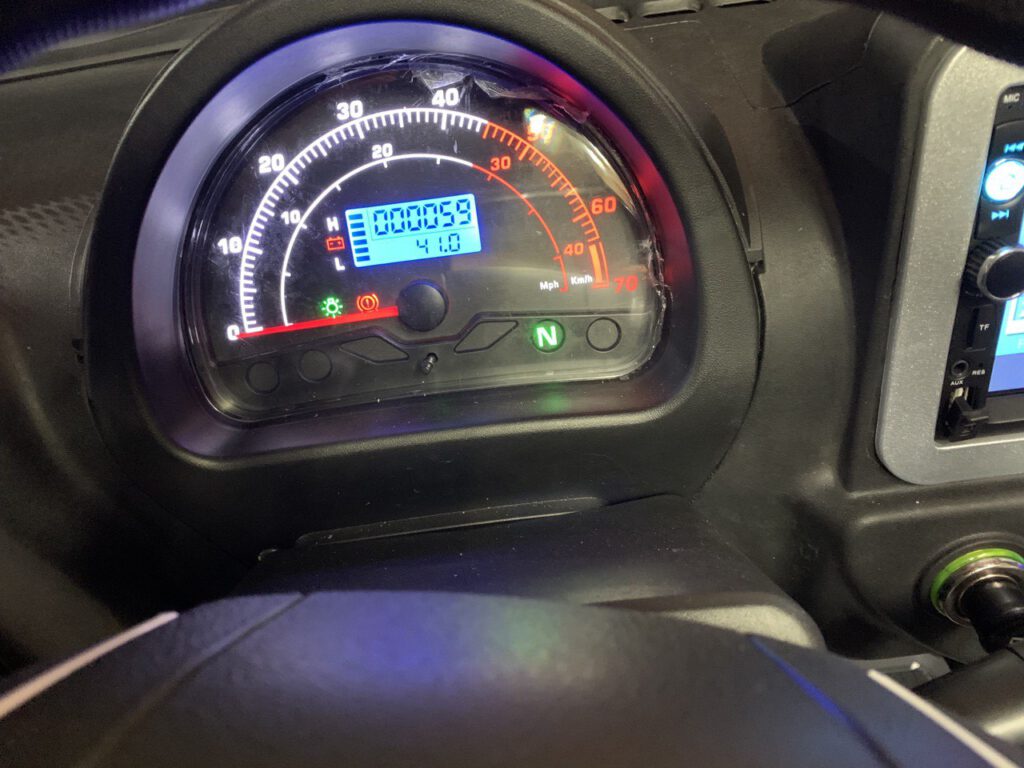
R When “R” indicator lights, it means you shifted to reverse gear. N When “N” indicator lights, it means you shifted to neutral gear. D When “D” indicator lights, it means you shifted to drive gear.
Reset of subtotal
2, Ignition switch
Off: turn key to this position, power will be cut off, cannot drive the vehicle, but light system works (including radio, cigarette lighter, lights, heater), key cannot be pulled out.
On: turn key to this position, powertrain system is switched on, can drive the vehicle, at the same time lights and all of the electrical devices work, key cannot be pulled out.
LOCK: turn key to this position, cut off whole vehicle
Turning indicator: the turn signal light installed on the instrument panel is the green signal. If it flashes when used it means front and rear turning light work normally. If it flashes too rapidly or does not work at all, please inspect the bulb. If the turning switch is opened and the indicator does not work, please inspect the fuse, bulb and flash relay. When you press the emergency switch, two indicators will flash at the same time.


High beam indicator:If this indicator lights it means high beam lights are on.


Battery power warning indicator: Turn the key to “ON”, when the battery voltage is lower than a certain value in driving, the last of the battery power indicator will start to flash. At this time, the vehicle can only drive 5-10 km. Please charge timely. As it indicates the battery voltage, due to the difference in the driving state of the vehicle (vehicle speed, acceleration), there are some voltage biases.
Note: In order to ensure the recording of the mileage effectively, it is recommended that users
reset the subtotal odometer after a full charge (press the reset button for 4 seconds). Charging the battery at less than a 110 kilometers range often, can effectively prolong the service life of the battery.
(①)Brake liquid level indicator: when brake liquid level is below standard level, the indicator will light. You must inspect your vehicle at once!
- (Red) Battery charging indicator: when battery is charging, indicator will light red, please don’t drive vehicle. If charger or cable has faults, indicator will flash.
- (Green) Battery full power indicator: when the battery has reached full power, indicator will light green, please pull out the charger.
Speed meter: show the speed(km/h), record the total mileage, and subtotal mileage.
power, lock steering wheel, can pull out key or insert key. If you cannot rotate the key at this position, please rotate the steering wheel slightly from left to right, then try to rotate the key again.
Please note that you cannot rotate the key to “LOCK” while driving, otherwise it will cause the steering wheel to lock and cause accidents. Please note: don’t put the key in the vehicle or leave a child alone in the vehicle.
3, Glass and sunroof care
Please ensure to close and lock the sunroof completely to avoid damaging the sunroof. When you open the sunroof, please unlock it and push it backward till it locks, it can be used to freshen the indoor air fast.
You cannot open the sunroof after rain, please keep driving for 5 minutes, only open the sunroof after the water between glass and frame is removed.


Open sunroof Close sunroof

4, Control switch
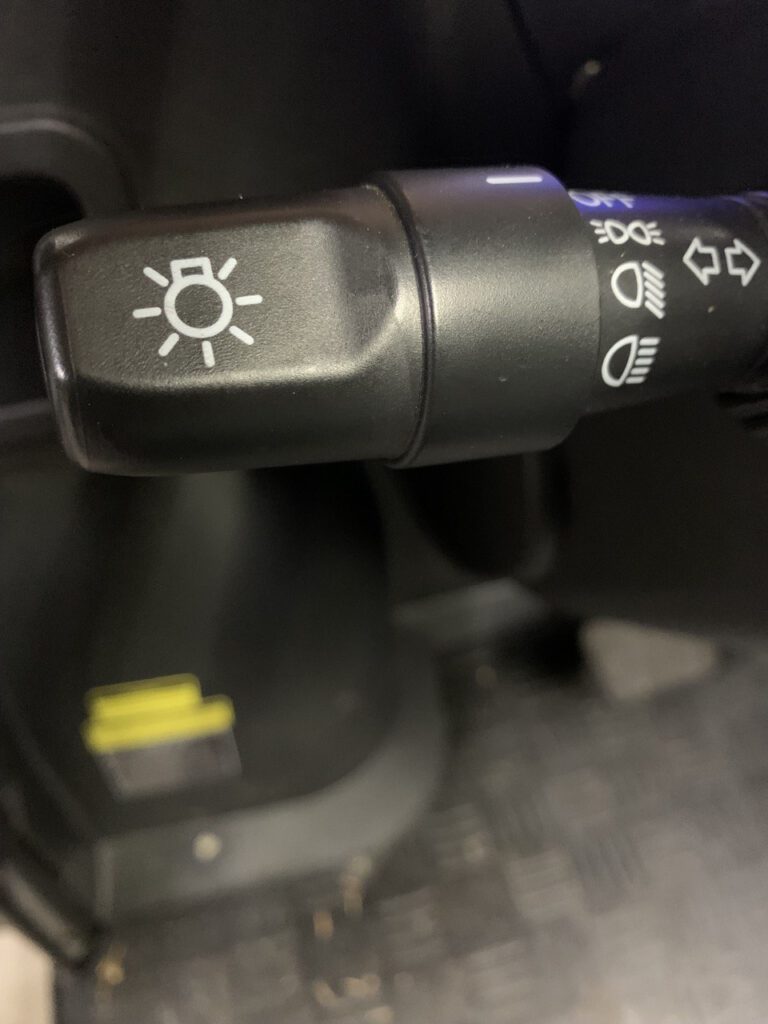
a, headlight and signal switch OFF: close all of lights;
Light position lamp ,tail light, license plate light; Light high beam, position lamp must also be lighted;
Light low beam, position lamp must also be lighted;
If the vehicle does not work, do not let the headlight and other lights work too long. This will cause excessive discharge of the battery.
In rain or after washing the vehicle, there will be some fog in the lamp lens, it’s the same as glasses which fog up in wet weather. It’s normal, it will be defrosted after lighting the lamps. But if water has gathered on the inside, please inspect your vehicle at a service center.
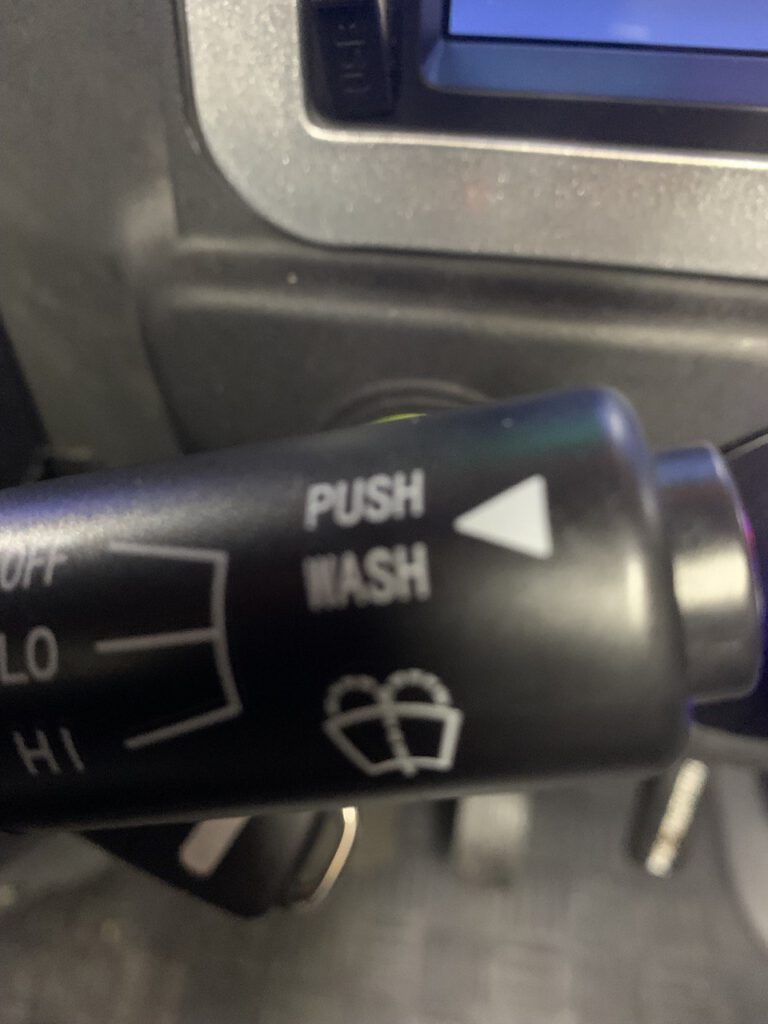
Washer switch: push and hold the lever forward to the steering wheel. The wiper nozzle will spray detergent on the windshield to clean the dust and/or defrost the windshield and avoid blocking your sight.
5, Emergency light switch
In case of an emergency, you must stop or park the vehicle. Please press the switch to inform other drivers. This time for all indicators to work, please note you need to rotate the key to “ON” position. Park the vehicle in case of an emergency or your car breaks down, please drive away from the road and stop. Unless you are forced by circumstances, please mind that driving slowly may lead to traffic accidents. After switching on the emergency switch, your indicators will not work properly
Turning signal
Emergency switch
After turning on turning signal switch (key at “ON” position), turning light will flash, turning indicator will flash at the same time.
b, Wiper
Wiper and washer have three tap positions: OFF-LO-HI OFF: close tap position.
LO: low speed tap position, wiper will work in low speed. HI: high speed tap position, wiper will work in high speed.
6, MultiMedia System
Please refer to the Multimedia System manual
7, Nature wind switch
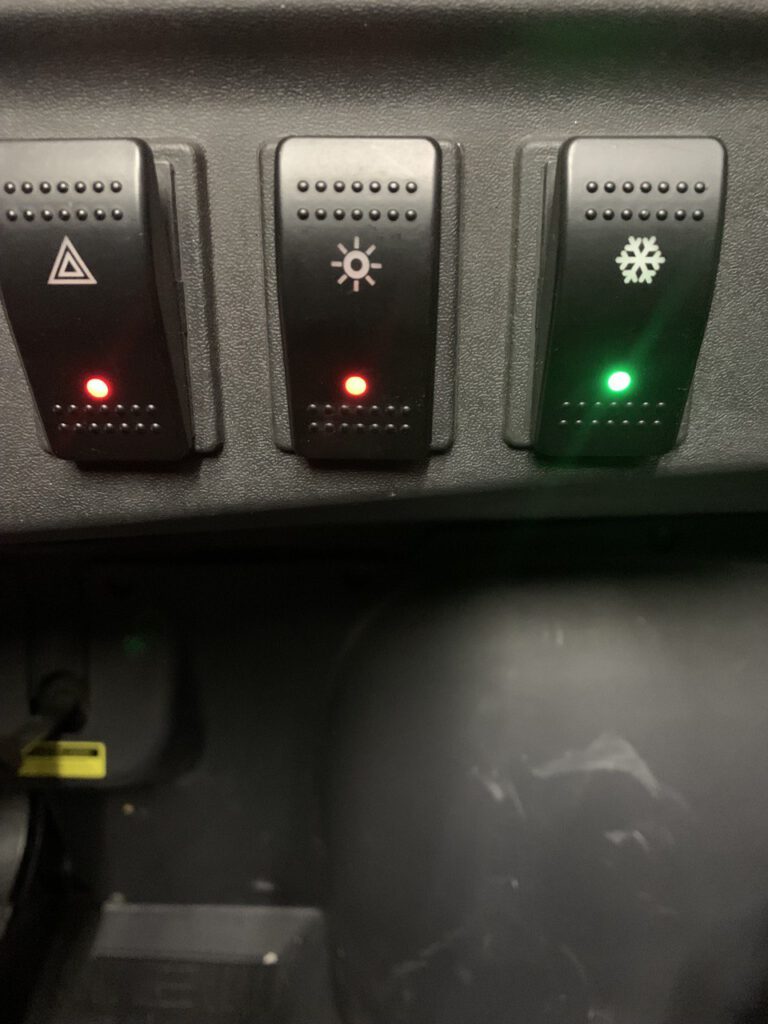
The natural wind switch is the second button from the left, located in the control panel. When the ignition switch is rotated to the ON position, pressing the switch will start the blower. The dashboard mist inlet and outlet blow out the natural wind. Ensure air entrance grid in front of the windscreen is not occluded.
8, Heater system
The heater switch is the third button from the left, located in the control panel. When the ignition switch is rotated to the ON position, you must press the natural wind button (or press heater button without action), and then press heater button, heater will start to work.
Nature wind switch Heater switch
9, Rear view mirror
The outside rear-view mirror can be adjusted manually, before driving the first time, you must adjust your left and right rear view mirror position to the most suitable position while in the driver’s seat. It can be folded in special conditions.
10, Cigarette lighter
When the ignition switch is rotated to “ON” position, you can operate the cigarette lighter. When you press the cigarette lighter, it will automatically be available and rattle. Pull it out and use it. After using it, insert the cigarette lighter into initial position. When not using, please don’t take it out of the socket, because the socket may be blocked by external materials, and cause a short circuit.
To avoid burns, please don’t touch the heating element or housing except for the handle, and also don’t allow children to play with the cigarette lighter. If the lighter fails to eject after pushing 30 seconds, it has errors. If the cigarette lighter cannot eject automatically, please repair it at a service center. Please note that if the cigarette lighter is inserted into lighting position for too long a time or a lighter from another vehicle is inserted, it will overheat or catch fire. We recommend to use the cigarette lighter socket only, use of other plug-in accessories will cause damage to the socket.
11, Charging interface
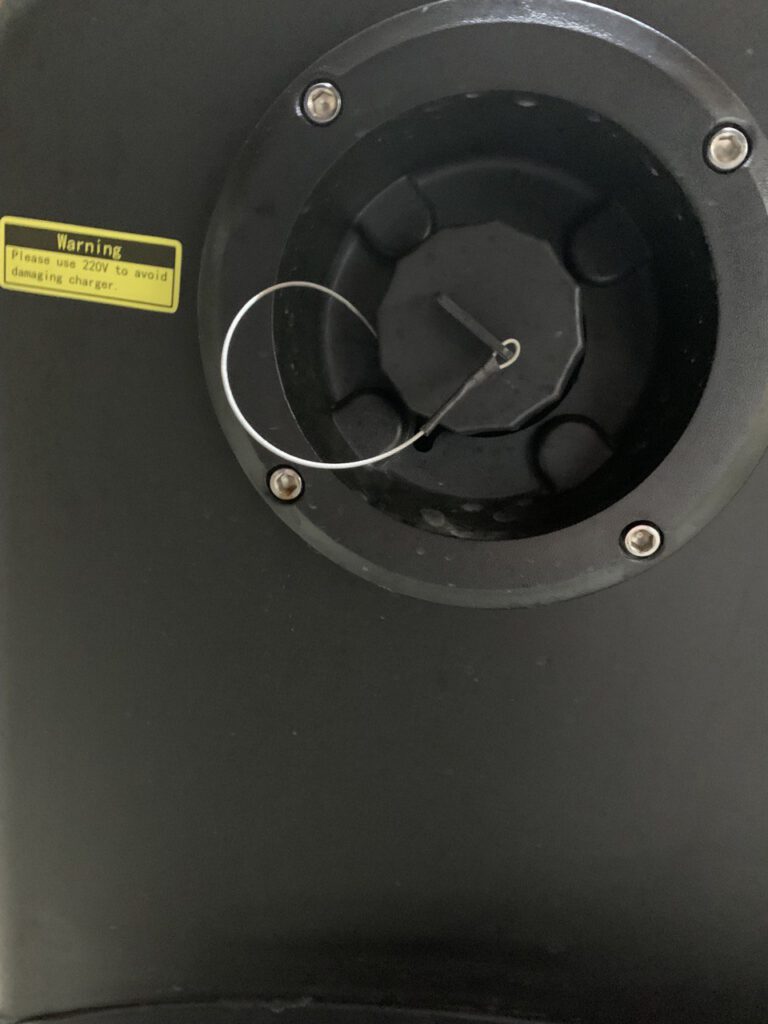
Located in the rear right side of the vehicle you can find the charging point. After twisting off the protective cover, you can charge the vehicle.
Please note: you need to turn on the main power switch before charging.
Section 5 Emergency
1, Flat tire
⑴ If for some reasons, you need to park the vehicle on the road, please move to the right-hand side of the road as far as possible, avoid parking in the driveway.
⑵ Tighten the parking brake, put the triangle warning to a proper position behind the
vehicle (no matter day or night)
Please note: triangle warning needs to be assembled with tools!
⑶ Tire blow-out
If the tire was punctured and needs to be replaced, you must first comply with the safety precautions: turn on the emergency lights. Park the vehicle in a non-traffic route and on the flat ground, make sure not to hurt yourself and/or damage vehicles. Tighten the parking brake, shift to reverse gear, turn off the power. Don’t replace the tire on a slope or a bumpy road, because it can be very dangerous!
Blocking the wheel
When the tire is flat, please find some blocks to jam the rear wheels and prevent accidents from happening.

2, Tools
The toolbag includes following tools:
⑴ Tool bag ⑵ Tow hook
⑶ Special wrench
⑷ Two ends cross screwdriver
⑸ Triangle warning
3, Towing vehicle
⑴ Traction premise
Please comply with the relevant local traction regulations when towing your vehicle.
Zhejiang Jonway Automobile Co recommends to please let the repairman tow your vehicle, incorrect traction will lead to accidents.
⑵ Towing attention
By using the right equipment, you will avoid damage to vehicle traction.
The transmission mechanism of the vehicle and the steering mechanism must be able to work normally.
Please use reliable traction chain. You must release the parking brake during towing, and shift to neutral, turn the ignition key to the “ACC” position.
⑶ Traction point
⑷ Traction load
a, Tractor weight must be more Traction than towed vehicle, traction force point must be less than the tractor weight.
b, Traction force will include traction force from the additional vehicle, so total traction force will exceed traction vehicle weight. Holes or mud will produce additional traction resistance, so will add traction load.
c, When the traction hook is towing the vehicle, keep the traction angle less than 15 degrees. If the traction angle is too large, it may result in damage to the vehicle, and even make the vehicle turn 180 °. To pull the vehicle from sand, snow or mud, the cable must come straight out from the front, not forming an angle with the hook.
⑸ Traction speed
The traction vehicle must proceed forward slowly, to avoid the impact force. High impact is very dangerous, it may cause the traction rope to fracture, thus damaging vehicles. If you want to pull the vehicle from a pit or mud, please maintain distance between the traction rope or pole. Once the traction rope fractures, it will have very big consequences.
4, Towing by tractor
⑴ Wrong traction method
You cannot use the method as shown in Pic (type A) vehicle towed by slings , using slings will damage the front bumper and front structure.
⑵ Correct traction method
a, If the vehicle must be towed over 50 km, all wheels must be off the ground (type B or C), as shown in Pic.
b, If the motor or differential gear has failed, all wheels must be off the ground (type B or C), as shown in Pic.
c, When you use front wheel off the ground traction (type D), please shift to N gear (N gear,
release parking brake.)
Note: The sightseeing car cannot be towed from the backside when all the wheels on the ground, because it may cause serious damage to the motor or the differential gear.


5, Inspect and replace fuse
Use the key to open the front panel in the front of the vehicle, it has a fuse box with various types of fuses at the lower part. Pull off and check whether the fuse is good one by one.
If the lights or other electrical components do not work, you should check the fuse. If the fuse has been burned, it needs to be replaced, the fuse box has three spare fuses. Turn ignition switch and ineffective parts off, pull out the fuses one by one and check them.
If the fuse has been burned, it should be replaced by a new one. You can only install the same amperage fuse marked on the fuse box cover. If you cannot find the same amperage fuse, please use a lower amperage fuse, but you must install the correct fuse as soon as possible. Please keep the replaced fuse for using again. The best way is to buy a set with spare fuses, to put in the car for emergency use. If the new fuse immediately burns, maybe the electrical system has faults or defects. Please inspect the vehicle in a JONWAY service center as soon as possible.
Never use a fuse which is higher than the rated amperage, or any other object to
replace the fuse, otherwise it will cause serious damage and may cause fire.
Section 6 Cleaning and maintenance
1, Front panel disassembly
⑴ Start the windscreen wiper, when the wiper arm reaches the top, please turn off the key, keeping the wiper arm at that top position.
⑵ Please dismount two side screws with a screwdriver.
⑶ Use the key to open the front panel lock, gently lift the front panel and then it can be removed.
2, Inspection
⑴ Wiper washing
The wiper washing function improves visibility, please check the liquid level. Washing composition is as follows: at a normal temperature the cleaning water and hardness are less than 205g/1000kg. At low temperatures (-18 ℃ ± 3 ℃): it needs a concentration of 50% methanol water solution. It is prohibited to drive without washing.
⑵ Brake liquid
Turn the key to ON position, if the brake fluid indicator lights, the brake fluid level is too low. Please check the level between the highest mark (MAX) and the lowest mark (MIN) soon. If you need to replenish this liquid, you can only use DOT4 synthetic brake fluid.
Note: the brake fluid will absorb moisture. Therefore, if the vehicle is used in a humidity higher area most of the time, the brake fluid should be replaced more frequently and faster than usual. Please go to a JONWAY service center to inspect and replenish brake fluid.
Brake fluid is harmful to the human body and is corrosive. In case of accidental contact, please wash the related body parts with cleaning water and neutral soap immediately and repeatedly. If put in the mouth by accident, seek medical advice immediately!
⑶ Battery
Batteries running 15~20 days nee to be checked timely for the battery electrolyte, and timely replenishment if necessary. (Note: each battery electrolyte hole should be replenished one by one)
Maintenance free batteries do not need to be checked for electrolytes.
3, Lamp maintenance A, Introduction
Operate the light switch to check if all the lights are working. If the light is not lit, it is usually due to a fuse or bulb failure. First check the fuse, if the fuse is not burned, then check the bulb. If fuse and bulb are ok, please drive your vehicle to a JONWAY service center for repairs.
⑴ High beam/low beam of headlight 35W*2/35*2,white
⑵ Position lamp of headlight—– 5W, white
⑶ Turning lamp of headlight 10W, amber
⑷ Brake and position lamp of combination taillight– combination LED
⑸ Turning lamp of combination taillight– 10W, amber
⑹ Reverse lamp of combination taillight– 16W, white
⑺ License plate lamp—– 3W*3, white B, General rules
⑴ Ensure light is turned off before replacing the bulb, and inspect whether corresponding contact point is oxidized or not.
⑵ Please replace the broken bulb by the same model and power the new bulb.
⑶ Please inspect the high and low beam of headlight after replacing their bulb.
⑷ The internal surface of headlights will cast a thin layer of water vapor in the morning, it’s not a problem, it is a normal phenomenon in low temperatures and moist air conditions. It will quickly disappear after lighting the lamp. If the water appears to be inside the headlight, namely the water infiltrate inside, please drive your vehicle to a JONWAY service center to be repaired.
⑸ Do not use dirty gloves to hold the bulb. The oil on your hand will affect the
bulb replacement next time. If the glass surface is dirty, you must use alcohol or paint thinner to clean it. Make it completely dry and then reinstall.
C, Light position adjustment method
Height adjustment method: a position for left and right headlight, insert screwdriver, turn clockwise, lift up light, lift down light conversely.
Left and right adjustment method: b position for left headlight, insert screwdriver, turn clockwise, turn light to left, conversely to right. Conversed adjustment for right headlight.


4, Cleaning
Often use a vacuum cleaner or soft brush to clean the dust off decorative pieces, plastic pieces and the seats inside the car. You may scrub the vinyl plastic and leather surface with a clean soft cloth with weak alkaline soap water, then dry with a soft cloth. Before using any fiber protector, you should read the manufacturer’s instructions. Some fiber protectors contain chemical agents, will leave the seat with stains or faded places. Never use gasoline, thinner or other solvents.
In the process of cleaning the vehicle, it is strictly prohibited to flush the cabin with water directly, you should avoid water flowing into the body of the charging socket. It is prohibited to use high-pressure water to rinse the chassis parts to avoid damage to the internal electronic components and circuit caused by water.
- Wet controller, electric circuit or motor, will cause short circuit and damage to the electrical equipment.
5, Anti – corrosive measures
⑴ The most common causes of corroding sightseeing car are:
a, Wet dirt, dust or debris in the body plate, holes and other parts of the body.
b, The sand blowing or coating resulting from minor accidents or other protective layer damages.
⑵ Environmental factors affecting corrosion rate:
a, Moist
Accumulated sand, dirt and moisture in the lower body will accelerate corrosion. The accumulated snow and ice under the floor of the vehicle is not easy to dry.
b, Relative humidity
Note: Corrosion would be accelerated in the following cases: areas with a high relative humidity, temperatures above freezing point, air pollution, or areas using road salt.
c, Air pollution
Industrial pollution, the salt in the seaside air and using too much road salt, will accelerate corrosion process.
⑶ Protection against corrosion of sightseeing car
Always scrub and wax the sightseeing car to keep the sightseeing car clean, often check the paint if there are small damages and repair them as soon as possible keeping the hole of door bottom and rear shield unobstructed to avoid water damages. Check the lower body, if there is sand, dirt and/or other salts, use water to scrub it clean as soon as possible. Do not wash the dust, sand or other sundries inside passenger compartment, you should use a vacuum cleaner or brush.
Do not let water or other liquids contact electronic components inside the car.
6, Self-maintenance
Note: Some of the daily and regular maintenance is necessary to keep the good mechanical properties of the vehicle.
The user should arrange special maintenance and general maintenance. As the owner, you are the only way to ensure your sightseeing vehicle maintenance.
General maintenance should include checking some items for daily driving. If you want
to keep your vehicle in continuous normal operation, these are the most basic requirements. In case of daily use of the vehicle, general maintenance should be carried out regularly. If you are aware of any abnormal sounds, vibrations or smells, you must check the reason or let a service center inspect your vehicle quickly. In addition, if you think that your vehicle needs repairing, please contact a service center in time.
Here is a list of maintenance projects that should always be carried out, unless there are special provisions:
⑴ Tire
Check the tire pressure regularly with a tire gauge in a service center, they must be adjusted to the specified pressure.
⑵ Wheel nut
Check the tires, ensure the wheel nut are not loose. Check the loosening of the wheel nut and tighten the nut according to the specified torque within a 1000km range.
⑶ Wheel alignment and balance
When driving on a flat road, if the vehicle is always tilted to one side, or when you are aware of the tire being uneven or having abnormal wear, it is necessary to align the wheel.
⑷ Wiper brush
If brush works abnormally, please check whether there are cracks or wear.
⑸ Lamp
Confirm that the front combination lamps, rear combination lamp and other lamps work normally, are installed firmly, and check the lighting in regular maintenance, after cleaning vehicles etc.
⑹ Warning lamp and buzzer
Confirm all of warning lamps and buzzers work normally.
⑺ Wiper and washer
Confirm wiper and washer work normally and brush without cracks.
⑻ Defroster
Check if the wind from the vent is normal and enough for using the heater.
⑼ Steering wheel
Check whether the steering situation has changed, such as free travel is too large or
there are abnormal sounds.
⑽ Accelerator pedal
Confirm the pedal works steadily, and check the free travel is normal.
⑾ Brake
Check vehicle if there is deviation in braking, and if the brake lining has excessive wear or not.
⑿ Brake pedal
Check whether the pedal works steadily, free travel is normal, and confirm that when the pedal is stepped to the end, it should reserve some trip.
⒀ Parking brake
Check whether parking brake is working normally.
7, Regular maintenance
⑴ Regular maintenance must be carried out in the specified time interval, it is required to ensure that your vehicle’s power system and mechanical system will perform well. These works shall be done in a JONWAY service center.
Note that running under bad conditions, your vehicle needs extra or frequent maintenance. The periodical maintenance is your responsibility.
⑵ The initial compulsive grinding maintenance
In the early of 500/2000 km, compulsory maintenance is one of the most important maintenances, ensuring your vehicle achieves the best state is very important.
⑶ Where to do regular maintenance and repairs
Every two thousand kilometers you should take your vehicle for regular maintenance. When you reach the maintenance time or your vehicle has a malfunction, please inspect and adjust your vehicle at a JONWAY service station. Repair technicians at JONWAY service centers are professional personnel and are trained regularly. Our technicians are trained through the technical manual, repairs, and repair service center training courses to get the latest repair information.
8, Battery maintenance
⑴ The surface of the battery, pole, connecting bolt, and connecting line should be kept clean and dry. If the electrolyte splashes on a body, please use cotton wipe clean, then wash and dry, ensuring no water enters into the battery.
⑵ Battery connection must be kept in good condition. Always check the battery connection fastening and nut loosening, lest it may cause a spark in driving to ablate electrode.
⑶ Don’t place any conductive materials on battery, cannot connect the battery’s positive and negative poles directly to avoid causing a short circuit and damaging the battery.
⑷ After battery discharge (regardless of vehicle’s range and driving time), it must be charged timely, and the charging time should never exceed 24 hours.
⑸ Because the electrolyte water electrolysis and evaporation will cause the density to increase and the level to be lower in using, you should always check this.
In the charging of the battery terminal, please adjust electrolyte density to 1.28
±0.005 (25 ℃) by 1.400 density dilute sulfuric acid specified for lead acid battery, make the liquid height the same as the max. level. Continue to charge 0.5-1 hours after adjustment, so that the internal consistency arises.
⑹ During charging, please put the vehicle in an airy place, and open the battery cover. After charging, tighten the liquid injection cover, ensuring smooth gas. Don’t charge while near smoking or near a stack of flammable goods.
⑺ When close to lead-acid battery service life, battery capacity will decline rapidly, it then must be replaced by a new battery. The new battery must be from the same original vehicle battery manufacturers and the same model. It should also be the similar voltage battery cell as a group (fully charged, the difference between the highest voltage shall not exceed 1.1V).
9, Battery charging method
⑴ The following preparations should be performed before charging:
a, Check the charging equipment, instruments and tools. Make sure they shall timely be prepared and repair them if there is a failure.
b, Must turn off the key.
c, Must use specified charger to charge and avoid damaging the battery.
d, Open the charging protective cover.
e, Please check the tightening of every connection part.
f, Must charge at an airy, dry place with no direct sunlight.
g, Start the main power switch.
h, Must ensure that the plug is inserted in the socket, and lock the screw socket.
⑵ Charging method
a, Power supply socket must match the charger plug. b, Charging voltage is 220V.
c, Disconnect the ignition switch, shift to neutral gear, remove the key, pull the handbrake. The main power button must be at starting place.
d, The charging plug is inserted into the charging port and tightened. Corresponding instrument indicator lights:
The red light on: charging;
Red light flashing: charging abnormal, please check the charging circuit is connected or if there are any charger faults.
The green light on: full power, namely completed charging.
10, Traction motor maintenance
Always clean the case of sediments and other attachments, to facilitate cooling.
11, Rear axle maintenance
⑴ Always remove the dirt and/or dust on rear axle ventilation plug.
⑵ Always check the oil hole bolt and oil drain bolt. You should timely tighten them or replace the sealing gasket once you have any leakage phenomena.
⑶ Clean the ventilation plug each 2000KM: check the gear oil level in bridge shell (open oil level plug to check).
⑷ Check left and right bridge pipe’s fastening situation each 2000km, check left and right “U” shaped bolt of bridge pipe fastening situation as well.
⑸ The first oil change mileage is 800KM. You must change the gear oil every 1500KM later .
Please make sure the service center is authorized by JONWAY AUTO before maintenance. You can believe that the authorized service center can meet the vehicle’s requirements in the reliability and economy of maintenance requirements.
Section 7 Parameter and specifications
1, Vehicle verification
⑴ Vehicle identification number (VIN)
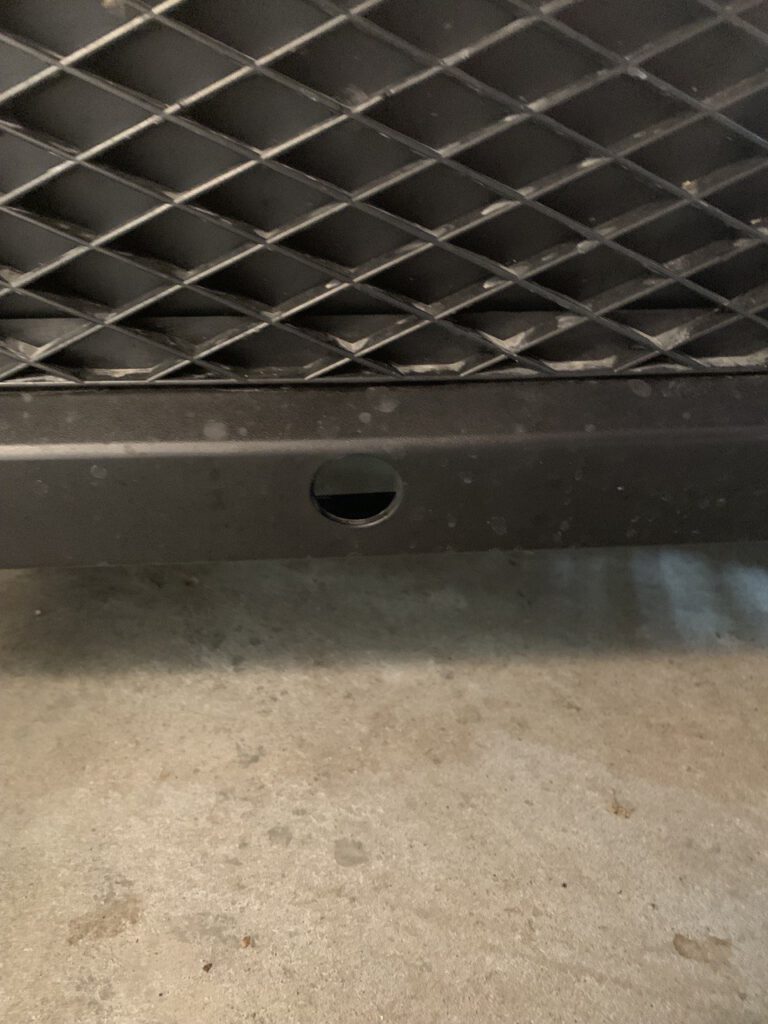
VIN is a unique 17-bit code to identify the vehicle body. This code is not only marked in the vehicle’s nameplate, but it is also marked on the front upper beam. It can be found by opening the front panel.
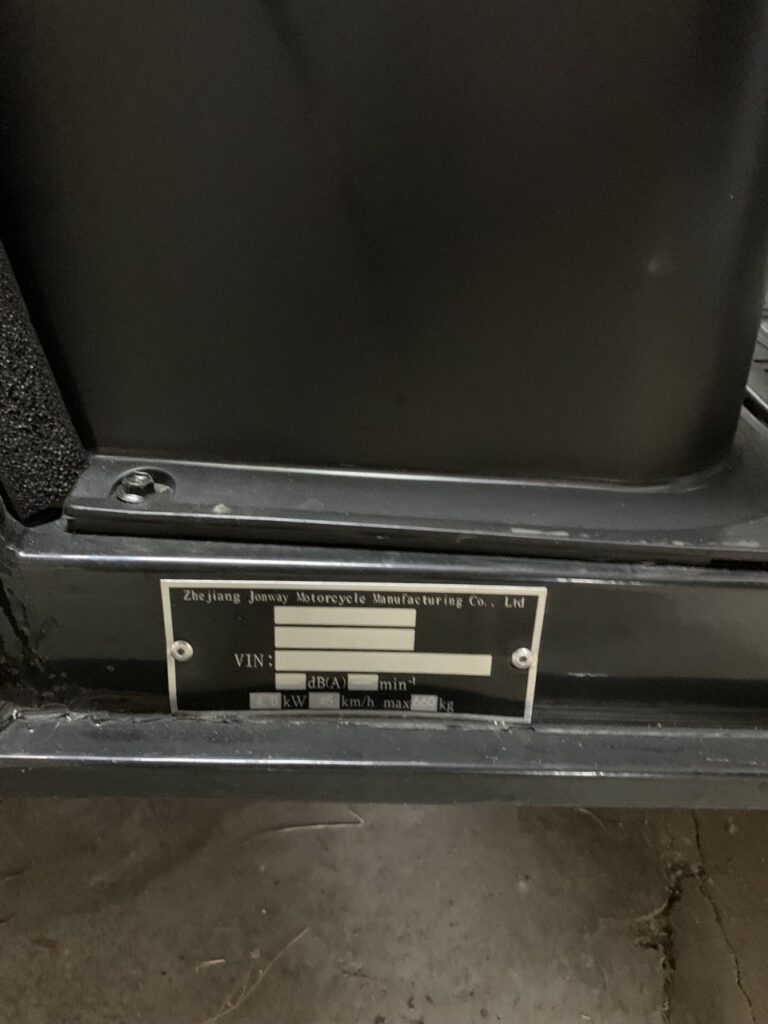
⑵ Vehicle mark plate
Every model has the mark plate mounted on left lower frame beam.
Markplate
2, Vehicle parameter and specifications Please check it on the next page.
Section 8 Loading and unloading
1, Fasten vehicle with frame, then lift vehicle and fasten on plate truck before transport.
2, Unloading the vehicle by forklift.
Note: To protect your vehicle and motor, please use specified oils (coolant, brake liquid, cleaning liquid etc.). All kinds of oil and liquids without matching test, can damage your vehicle after using.